Legal definitions of these terms vary by jurisdiction and by regulatory framework — a dataset that counts as "de-identified" under one standard may not meet the bar for "anonymized" under another. This is one reason legal and privacy teams should be involved in setting the actual technique and threshold used, not just engineering.
Why AI Makes Data Anonymization More Important
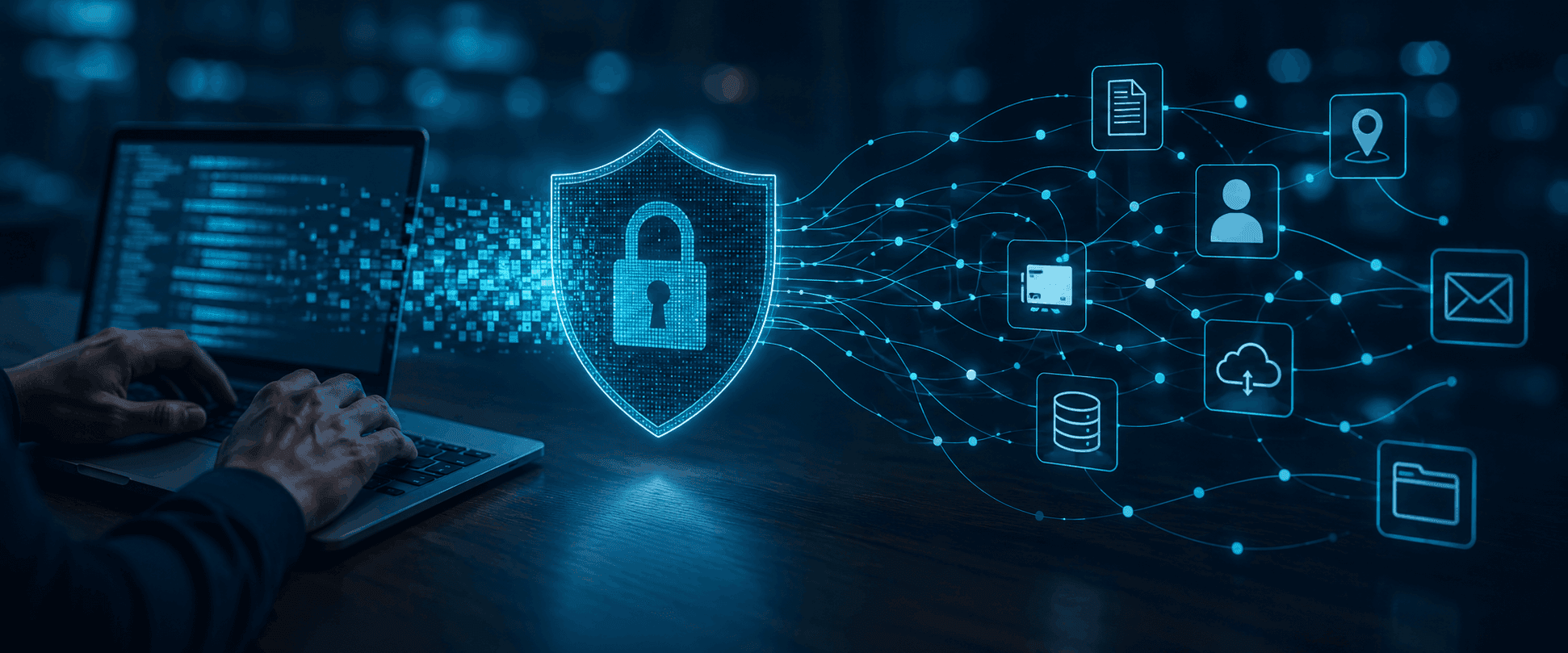
Enterprise AI systems process an unusually wide range of sensitive material: emails, contracts, customer records, support tickets, HR files, financial records, legal documents, healthcare information, internal conversations, and source code all regularly pass through AI tools, often without a formal review step.
What's changed isn't just the volume of data moving around — it's the number of new pathways that data can travel through. A single AI workflow might touch prompts typed by employees, files uploaded to an assistant, API calls between internal systems and a model provider, retrieval systems pulling from a knowledge base, autonomous agents chaining together multiple tools, logs and observability platforms capturing everything for debugging, and third-party processors or model providers sitting downstream of all of it.
The privacy risk with enterprise AI is not only what data an organization stores. It's also what data it sends into AI workflows — often in real time, often without a human reviewing it first, and often to a system the organization doesn't fully control. That shift is why anonymization and sanitization have moved from a compliance checkbox to an operational requirement.
What Is AI Data Anonymization?
AI data anonymization is the practice of detecting and transforming sensitive or identifying information before it reaches an AI model, so the model processes reduced-risk content instead of raw enterprise data.
In practice, this involves several overlapping capabilities: identifying PII and other sensitive data, then applying an appropriate transformation — masking, redaction, tokenization, pseudonymization, or entity replacement — depending on the data type and the intended use. Structured data (spreadsheets, database fields) is comparatively straightforward to handle because the schema tells you where to look. Unstructured data — a contract, an email thread, a free-text support ticket — is harder, because sensitive information can appear anywhere, in any format, without a predictable pattern. Effective AI data anonymization has to handle both, and increasingly has to do so automatically, at the speed AI workflows operate.
What Data Sanitization Automation Reduces AI Risk?
Automated data sanitization reduces AI risk by detecting and transforming sensitive information — PII, credentials, confidential business content — before it's sent to an AI model or any downstream AI service, so the model never processes the raw, identifying version of the data in the first place.
The underlying workflow generally follows six stages:
Detect → Classify → Transform → Validate → Send → Monitor
- Detect identifies where sensitive information exists in the content.
- Classify determines how sensitive it is and which policy applies.
- Transform applies the right technique — redaction, masking, anonymization, pseudonymization, or tokenization.
- Validate checks that the transformation actually worked and nothing sensitive slipped through.
- Send passes only the transformed content to the AI system.
- Monitor tracks exceptions, policy violations, and changes in what's flowing through the pipeline over time.
Automation matters here because manual review doesn't scale to the volume and speed of modern AI usage — employees sending prompts throughout the day, agents making dozens of API calls per task, documents being ingested in bulk. A sanitization layer that runs automatically, before data leaves the organization's control, closes a gap that policy documents alone can't.
How Automated AI Data Sanitization Works
Walking through a realistic enterprise pipeline:
Step 1: Detect. The system scans incoming content for names, email addresses, phone numbers, physical addresses, financial details, government identifiers, healthcare information, credentials, API keys, and confidential business information. This typically combines pattern matching (for structured identifiers like emails and account numbers) with natural language models trained to recognize named entities in free text.
Step 2: Classify. Detected items are categorized by sensitivity and mapped to the organization's policy — a customer's first name might be treated differently than their Social Security number or a company's unreleased financial results.
Step 3: Transform. Each category gets an appropriate treatment. Some fields are redacted outright, others masked or tokenized, others pseudonymized so the AI still has usable context without seeing the real value.
Step 4: Validate. Before anything is sent onward, the system checks whether sensitive information remains — a validation pass catches cases where detection missed something or a transformation was incomplete.
Step 5: Send. Only the sanitized version of the content reaches the AI model, agent, or third-party service.
Step 6: Monitor. Ongoing monitoring tracks policy exceptions, unusual data flows, and drift in what kinds of sensitive information are showing up, feeding back into detection rules and governance review.
Data Sanitization vs. Data Anonymization
Data sanitization is the broader operational process of identifying and neutralizing sensitive or risky content before it moves somewhere it shouldn't. Anonymization is one specific technique that can be used within that process — but sanitization also covers redaction of credentials, removal of confidential business terms, and masking of values that aren't personal data at all (an unreleased product name, for instance).
Put differently: anonymization asks "can this data still be tied to a person?" Sanitization asks the broader question, "is there anything in this content that shouldn't be exposed to this destination?" An AI prompt sanitization pipeline might remove a customer's name (anonymization) and strip out an internal API key that has nothing to do with personal privacy at all (a sanitization step with no anonymization angle whatsoever).
Can Anonymized Data Be Re-Identified?
Sometimes — and whether it can depends on the data itself, the transformation method used, and what other information is available to whoever is trying to re-identify it.
The mechanisms behind this are worth understanding directly:
- Linkage attacks combine a de-identified dataset with an external dataset (public records, a previous data breach, a social media profile) to re-establish identity.
- Quasi-identifiers — ZIP code, birth date, gender, job title — seem harmless individually but can uniquely identify someone in combination. Research on this pattern has repeatedly shown that a surprisingly small number of quasi-identifiers can narrow a population down to a single person.
- Small datasets carry more risk than large ones, because there are fewer plausible matches to hide among.
- Unique attributes — a rare medical condition, an unusual job title, a specific transaction amount — can single someone out even when every "identifier" in the traditional sense has been removed.
The practical lesson: "we removed the names, so the data is anonymous" is not a safe assumption. Names are the most obvious identifier, but they're rarely the only one that matters.
What Are the Limitations of Data Anonymization?
Anonymization is a control, not a complete AI security strategy. Its real-world limitations include:
Loss of data utility — the more aggressively data is generalized or altered, the less useful it becomes for the AI task it was meant to support.
Re-identification risk — as covered above, this doesn't disappear just because direct identifiers are gone.
Imperfect detection — automated and manual detection both miss things, particularly in messy, unstructured text.
Context-dependence — data that's safely anonymous in one context (an internal analytics dashboard) may not be anonymous in another (a public dataset combined with other public data).
Indirect identifiers — often overlooked because they don't look like PII on their own.
Unstructured data — much harder to sanitize comprehensively than structured database fields.
Model-specific risks — some AI systems retain or log inputs in ways that create new exposure even after data has been transformed.
Implementation errors and false confidence — a poorly configured or outdated anonymization process can create a false sense of security that's arguably worse than having no process at all.
Why Unstructured Data Makes AI Anonymization Harder
Sensitive information doesn't stay neatly inside database columns. It shows up in contracts, PDFs, emails, meeting notes, customer messages, chat transcripts, scanned documents, source code, and free-text fields buried inside otherwise structured systems.
Traditional database masking tools were built for a world where sensitive data lived in predictable rows and columns. Enterprise generative AI breaks that assumption constantly — an employee might paste an entire email thread into a chatbot, or an AI agent might read a PDF contract as part of a workflow. Detecting and transforming sensitive content in that kind of freeform text requires natural-language understanding, not just pattern matching against a known schema. This is one of the biggest gaps between traditional data governance tooling and what enterprise AI actually requires.
What Is Prompt Sanitization?
Prompt sanitization is the process of detecting and transforming sensitive information within a prompt before it's submitted to an AI system, so the model gets the context it needs without receiving the raw identifying details.
For example, a raw prompt might read:
"Summarize this customer's complaint: Sarah Johnson, email sarah@example.com, account 44829..."
A sanitized version of the same prompt would read:
"Summarize this customer's complaint: [CUSTOMER_NAME], email [EMAIL], account [ACCOUNT_ID]..."
The AI can still complete the task — summarizing the complaint — without ever processing Sarah's actual name, email address, or account number. This preserves the utility of the prompt while reducing unnecessary exposure. It's worth being direct about the limits here too: prompt sanitization reduces what a specific request exposes, but it doesn't address every AI risk on its own — access controls, output handling, and governance around the broader system still matter.
How Data Sanitization Reduces Enterprise AI Risk
Sanitization connects to a wider set of enterprise concerns beyond privacy in the narrow sense: security, regulatory compliance, data leakage prevention, oversight of third-party AI providers, "shadow AI" usage that IT never approved, employee use of consumer AI tools for work tasks, autonomous AI agents operating with broad system access, and API-based integrations that move data between systems automatically.
The core mechanism is straightforward: sanitization reduces the amount and sensitivity of information exposed to downstream AI systems. It doesn't eliminate risk outright, and it isn't a substitute for the rest of a security program — but it materially shrinks the blast radius if something does go wrong, whether that's a misconfigured integration, an overly broad AI agent permission, or a prompt that gets logged somewhere it shouldn't.
What Data Should Organizations Sanitize Before Sending It to AI?
Not every piece of data needs the same treatment. The right approach depends on purpose, sensitivity, applicable legal requirements, business context, the specific AI workflow involved, and the organization's risk tolerance. Categories worth reviewing systematically include:
Personal information — names, addresses, phone numbers, email addresses.
Sensitive personal information — health data, financial data, and other legally or contractually sensitive categories, where applicable.
Credentials — passwords, API keys, authentication tokens, session data.
Confidential business information — trade secrets, pricing strategy, unreleased product plans, strategic documents.
Legal information — contracts, legal correspondence, and privileged or confidential material where applicable.
Customer information — support tickets, account details, communication history.
Employee information — HR records, performance reviews, internal personnel documents.
Intellectual property — proprietary source code, technical designs, internal documentation.
Common Data Anonymization Techniques
Enterprises typically draw from a consistent toolkit of techniques, each suited to different data types and use cases:
- Suppression — removing a data element entirely.
- Masking — obscuring a value while preserving its format (e.g., showing only the last four digits of an account number).
- Generalization — reducing precision (an exact age becomes an age range; a street address becomes a city).
- Aggregation — combining individual records into summary statistics.
- Perturbation — introducing controlled noise into numerical data.
- Pseudonymization — replacing identifiers with consistent stand-in values.
- Tokenization — replacing sensitive values with reference tokens tied to a separate, secured lookup system.
- Redaction — removing or blacking out sensitive content.
- Replacement — substituting a value with a category label (e.g., a name becomes [CUSTOMER_NAME]).
Two related academic concepts come up often in privacy engineering discussions and are worth knowing at a high level. K-anonymity is a property where each record in a dataset is indistinguishable from at least k-1 other records based on its quasi-identifiers, making individual re-identification statistically harder. Differential privacy is a mathematical framework for adding calibrated noise to query results or datasets so that the presence or absence of any single individual's data doesn't meaningfully change the output — a stronger, more formal privacy guarantee than most enterprise anonymization achieves in practice. Both are more common in research and large-scale data-release contexts than in day-to-day enterprise AI workflows, but understanding the underlying idea — indistinguishability and bounded influence of individual records — helps explain why some anonymization approaches are more rigorous than others.
Real-World Enterprise AI Anonymization Examples
Healthcare — Detailed patient information is transformed into de-identified clinical context an AI system can analyze without exposing the individual's identity.
Finance — A customer's specific transaction record is converted into a sanitized financial pattern suitable for AI-driven fraud detection or trend analysis.
Customer support — A customer complaint has personal identifiers removed before an AI system summarizes or categorizes it.
HR — An employee relations case has personally identifying details stripped out before AI assists with pattern analysis across cases.
Legal — A contract has names, account numbers, and other confidential identifiers removed before AI reviews it for specific clauses or risk terms.
Software development — Source code and log files have credentials and secrets removed before being shared with an AI coding assistant.
Does Anonymization Make Data Compliant?
Not automatically. Whether anonymized or de-identified data falls outside a given privacy law's scope depends on the jurisdiction, the type of data involved, the specific anonymization standard applied, the context of use, whether re-identification remains realistically possible, the applicable regulation, and internal organizational policy.
It's inaccurate to claim that anonymized data is always outside the reach of privacy law — some frameworks set a genuinely high bar for what counts as "anonymous" (effectively irreversible), while others recognize de-identified data as a lower, still-regulated tier. Organizations should treat "does this meet our compliance obligations" as a separate question from "does this reduce privacy risk," and involve legal or compliance expertise in answering the first one rather than assuming a technical transformation settles it.
How Does HIPAA Treat De-Identified Information?
HIPAA — a US healthcare privacy framework, not a universal definition of anonymization — recognizes two methods for de-identifying protected health information (PHI): Safe Harbor and Expert Determination.
The Safe Harbor method requires removing 18 specific categories of identifiers (names, dates directly tied to an individual, geographic detail smaller than a state, contact information, and others), along with confirming the covered entity has no actual knowledge that what remains could still identify someone. The Expert Determination method instead relies on a qualified expert applying statistical and scientific methods to determine that re-identification risk is very small, documenting that analysis. HHS's own guidance is explicit that neither method eliminates all re-identification risk — both are designed to bring risk down to a low, acceptable level, not to zero. Because this standard applies specifically to PHI handled by HIPAA-covered entities and their business associates, it shouldn't be treated as a general-purpose definition of "anonymous" outside the healthcare compliance context it was written for.
Anonymization vs. Pseudonymization
The practical difference comes down to reversibility. Anonymization aims to remove the ability to reasonably re-identify someone; pseudonymization deliberately keeps a mechanism — a lookup table, a cryptographic key — that can reconnect the pseudonym to the original identity under the right conditions.
That reversibility isn't necessarily a flaw. Pseudonymization is often the right choice for operational systems where an organization legitimately needs to re-link data later (fraud investigation, customer service, longitudinal analytics) but wants to limit exposure of the raw identifier in day-to-day processing. The tradeoff is that pseudonymized data carries more residual risk than genuinely anonymized data, because the re-linkage mechanism is itself a security dependency — if it's exposed or compromised, the pseudonymization protection collapses.
Anonymization vs. Redaction
Anonymization aims to reduce identifiability broadly, often while preserving as much of the data's analytical usefulness as possible. Redaction takes a narrower, more absolute approach: specific information is removed or concealed outright, with no attempt to preserve statistical utility for that field.
In AI workflows, redaction tends to fit situations where a piece of information simply shouldn't be seen at all — an API key, a Social Security number, privileged legal content — while anonymization fits situations where the AI still needs useful context (a customer's general profile, a transaction pattern) but shouldn't see the specific identifying details behind it.
Anonymization vs. Data Masking
Masking obscures a sensitive value while typically preserving its format and some structural properties — a credit card number might be shown as ****-****-****-4821, retaining the pattern of a card number without revealing the full value. Anonymization is a broader goal (reducing identifiability of a person), and masking is one way to work toward it, but masking alone doesn't necessarily address indirect identifiers or contextual re-identification risk the way a more comprehensive anonymization approach would.
A useful way to hold these apart: masking changes how a value looks; anonymization is concerned with whether a person can still be identified once you account for everything the data reveals, together.
Why AI Agents Increase the Need for Data Sanitization
AI agents introduce a different risk profile than a single chatbot conversation. An agent might retrieve information from multiple internal systems, call APIs, access enterprise applications, read documents, execute multi-step workflows, and move data between sources — often with less direct human oversight at each individual step than a person manually copying and pasting information would have.
That combination of broader access and reduced step-by-step visibility is why data sanitization matters more, not less, as agentic AI usage grows. The practical response isn't to avoid agents — it's to pair them with the same fundamentals that apply everywhere else in security: least privilege (agents only access what the task actually requires), data minimization (agents only see the data necessary to complete the task), sanitization (sensitive content is transformed before it reaches or leaves the agent), and monitoring (unusual data flows get flagged for review). None of this requires overstating what agents can currently do — the risk comes from ordinary data access at a higher volume and speed, not from exotic agent capabilities.
Where Data Anonymization Fits in a Privacy-First AI Architecture
A privacy-first AI architecture treats data protection as something that happens before information reaches a model, rather than something bolted on afterward. Conceptually, the flow looks like this:
Enterprise Data → Detection → Classification → Sanitization → AI Model → Output Controls → Monitoring
Raw enterprise data is first discovered and classified, sensitive elements are detected and transformed through sanitization (including anonymization, masking, redaction, or tokenization as appropriate), and only then does the reduced-risk version reach the AI model. Output controls and ongoing monitoring close the loop, catching issues in what the AI produces and tracking how data flows through the system over time.
The reason this matters: relying solely on an AI model provider's own privacy and security commitments puts the organization in a position of trusting a third party with data it hasn't controlled the exposure of. A privacy layer that sits before the model gives the organization control over what leaves its environment in the first place, regardless of which AI provider or model is being used downstream.
How Questa AI Supports Privacy-First AI Data Processing
Enterprises adopting AI face a structural problem: AI systems are useful precisely because they can process large volumes of business data, but that same data often contains information that shouldn't reach a third-party model unfiltered. A privacy layer positioned between enterprise data and AI systems is one way to resolve that tension without giving up on AI adoption altogether.
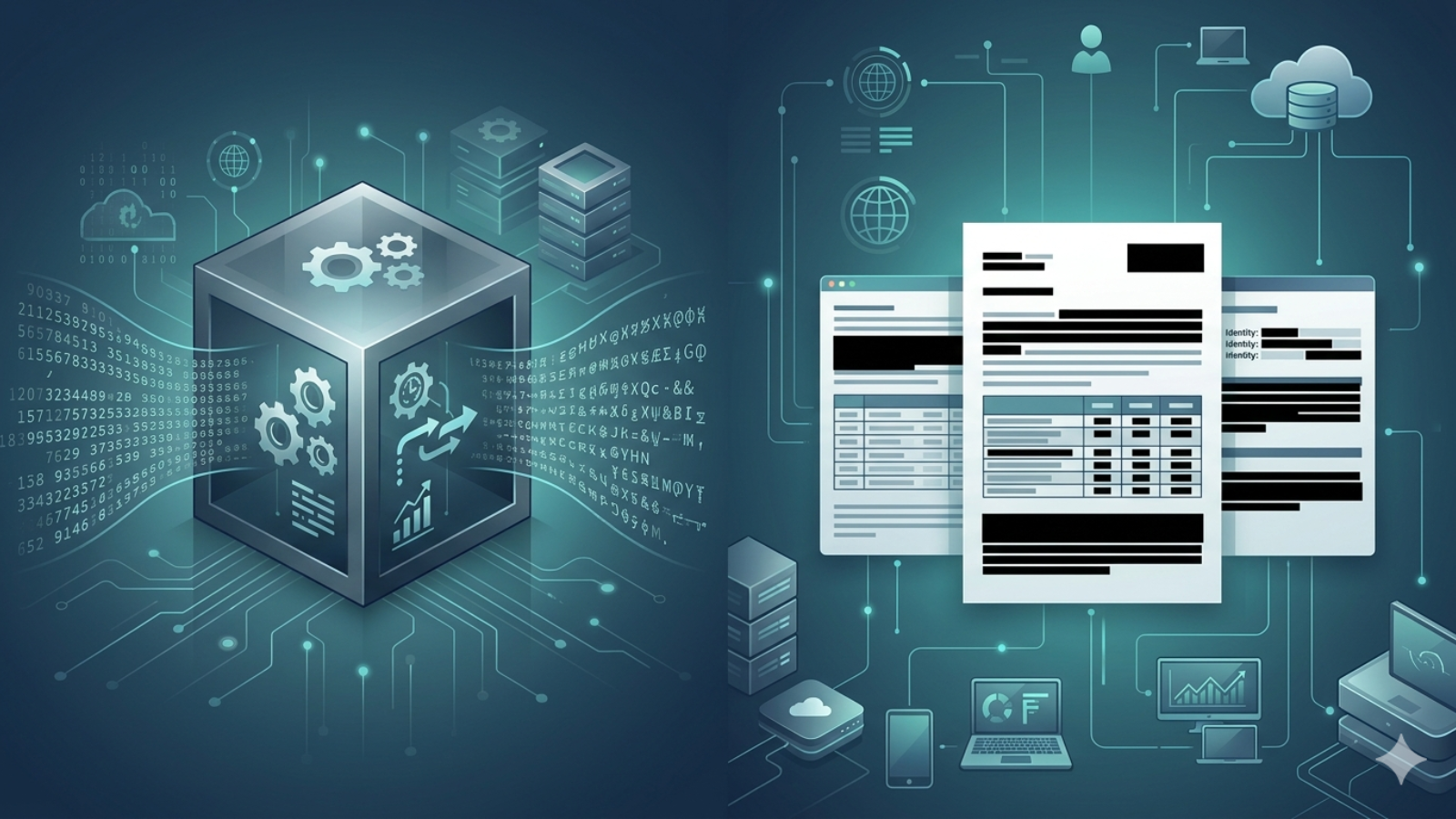
Questa AI is built around this idea, functioning as a privacy layer that sits between an organization's data and the AI models processing it. Its anonymization capability is designed to detect and transform sensitive information — including PII — across both structured formats and unstructured documents such as PDFs, Word files, and spreadsheets, reconstructing the original file format after sanitization so the underlying document remains usable. This kind of blackbox anonymization approach lets an AI model process the context it needs to complete a task without the model ever seeing the raw, identifying values underneath. Questa AI is aimed at regulated and sensitive-data environments — healthcare, financial services, legal, and BPO/contact center operations — where organizations need to use AI on data like clinical notes, contracts, financial records, or customer communications without exposing the underlying identities.
None of this should be read as a claim of guaranteed compliance, guaranteed anonymity, or zero risk. A privacy layer reduces exposure — it doesn't replace a security team, a governance program, or legal counsel, and the limitations discussed earlier in this article (residual re-identification risk, context-dependence, detection accuracy) apply to any anonymization technology, regardless of vendor. What a dedicated privacy layer changes is where protection happens — before data leaves the organization's control, rather than relying entirely on downstream model providers to handle it correctly.
Enterprise AI Data Sanitization Checklist
- Identify which AI use cases actually touch sensitive data
- Map data flows across prompts, uploads, APIs, and agent workflows
- Classify data by sensitivity and applicable policy
- Identify both direct and indirect identifiers in the data involved
- Define clear sanitization policies for each data category
- Select transformation techniques appropriate to each use case
- Test for residual re-identification risk, not just presence of obvious identifiers
- Validate sanitized output before it reaches an AI system
- Control access to both raw and sanitized data
- Monitor AI data flows on an ongoing basis, not just at initial rollout
- Review third-party AI processors and their data handling practices
- Audit sanitization policies against actual usage periodically
- Reassess as new AI use cases, tools, and agents are introduced
When Should an Enterprise Consider Automated AI Data Sanitization?
Manual review works when AI usage is small and centralized. It stops working once employees across multiple departments are using AI tools independently, once agents are making automated calls to multiple systems, or once the volume of prompts and documents flowing into AI tools outpaces what a privacy or security team can realistically review by hand. That inflection point — usually somewhere between "a few people experimenting" and "AI embedded in daily workflows" — is when automated sanitization moves from a nice-to-have to an operational necessity.
What Should an Enterprise Look for in an AI Data Privacy Solution?
Coverage of both structured and unstructured data, accurate detection across the specific data types the organization actually handles (not just generic PII), transformation techniques that preserve enough context for the AI task to remain useful, validation that checks for residual sensitive content rather than assuming detection worked, deployment options that fit the organization's infrastructure and data residency requirements, and monitoring or audit capability that supports ongoing governance rather than a one-time setup.
Should Sanitization Happen Before or After AI Processing?
Before, whenever the goal is to reduce what the AI model itself sees. Sanitizing after the fact can still be useful for filtering AI-generated output, but it doesn't address the exposure that already happened when raw data reached the model, was logged, or was retained by a third-party provider during processing.
Can AI Data Sanitization Work With Unstructured Data?
Yes, though it requires different techniques than structured data masking. Effective unstructured data sanitization typically combines natural language detection models with document-format handling, so that a contract, email, or scanned PDF can be scanned for sensitive content, transformed, and reconstructed in its original format without losing its usability.
Can Organizations Automate PII Detection Before AI Processing?
Yes — automated PII detection is one of the more mature parts of this space, typically combining pattern-based matching (for structured identifiers like emails, phone numbers, and account numbers) with natural language models trained to recognize names, locations, and other entities in free text. Automation reduces the manual review burden significantly, though ongoing validation is still necessary since no detection approach catches everything with perfect accuracy.