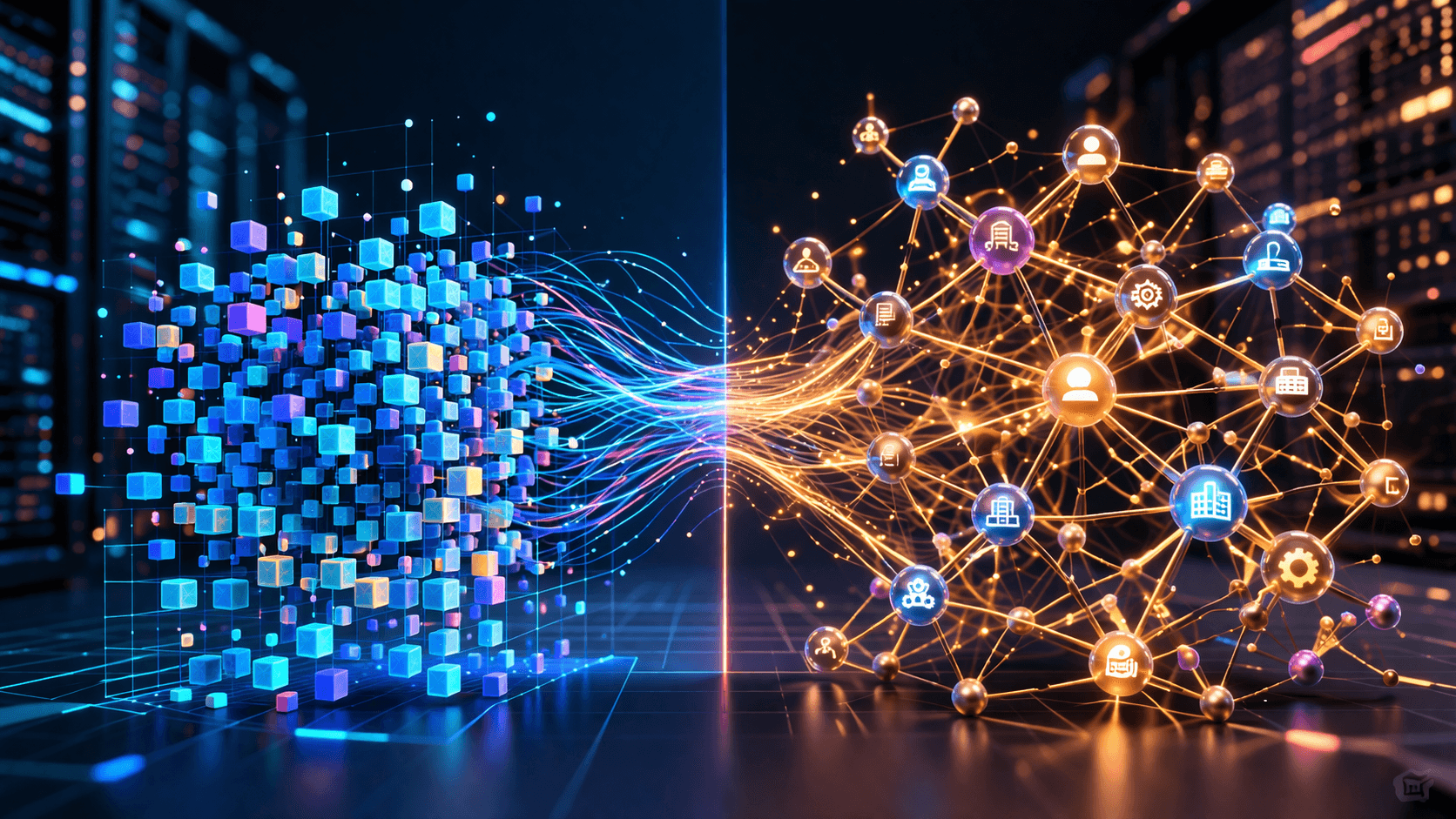
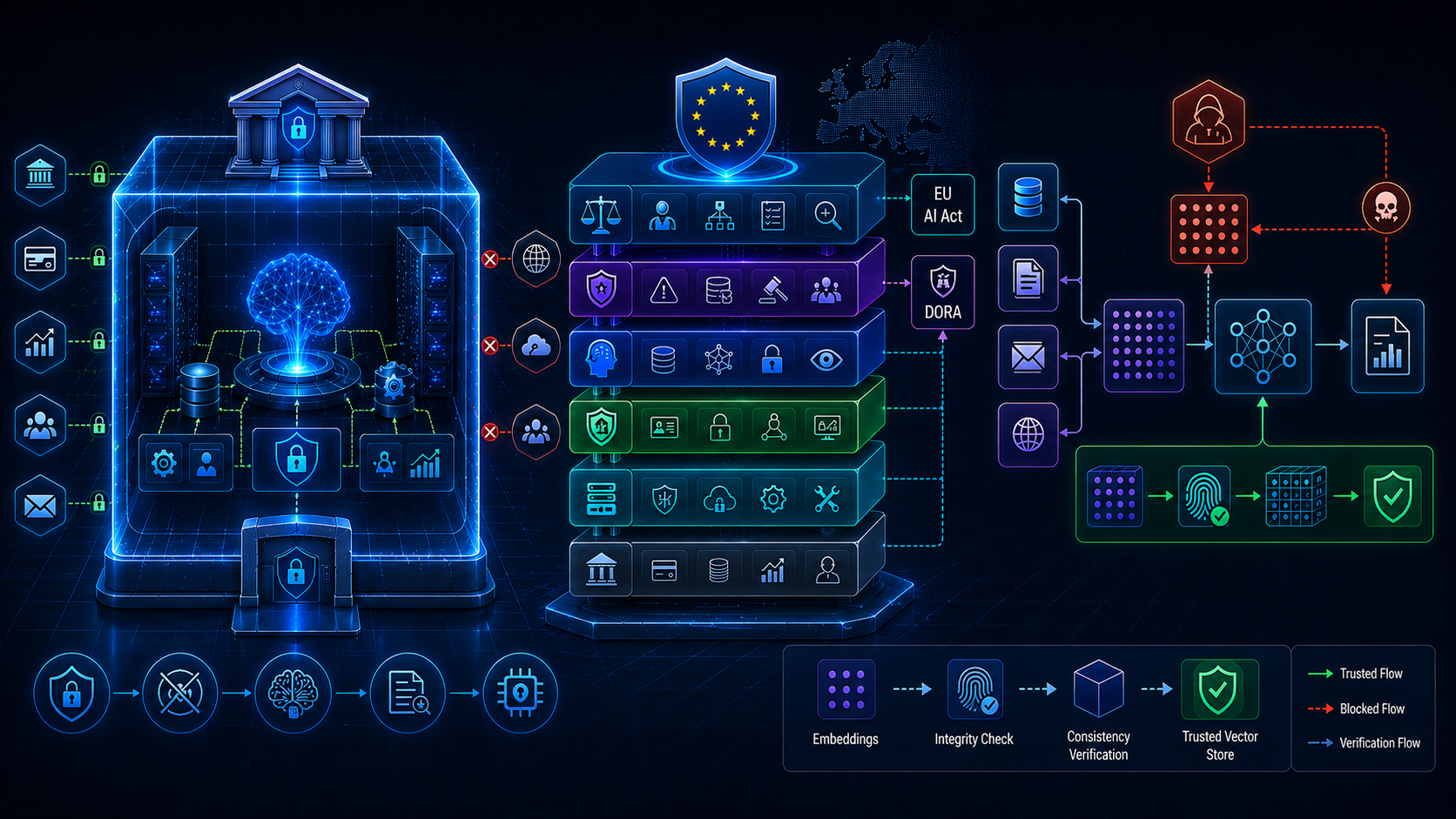
The Diffbot KG-LM Benchmark tested both approaches across 43 enterprise questions. VectorRAG achieved zero accuracy on KPI tracking and strategic planning categories. GraphRAG achieved 3.4x overall accuracy improvement — and 90%+ accuracy for schema-heavy queries with current production tooling. But accuracy is only half the story for regulated enterprises. GraphRAG's relationship-based architecture also solves a compliance problem that no VectorRAG implementation can: entity-level access control and a native audit trail. This guide covers both.
Why VectorRAG Hits a Wall on Enterprise Queries
For the past two years, the default Enterprise RAG architecture has been straightforward: chunk documents into segments, embed them into a vector database, retrieve the top-k results by cosine similarity, pass them to an LLM as context.
This works well for simple semantic queries:
- "What is our remote work policy?"
- "Summarize this contract's termination clauses"
- "What did Q2 guidance say about inventory?"
It fails on queries that require understanding relationships between entities across multiple documents:
- "How did the supplier delay affect downstream revenue across regions?"
- "Which counterparties have cross-exposure to both the credit and the rate book?"
- "What's the treatment pathway for this patient given their drug interaction history?"
The issue isn't the LLM — it's the retrieval architecture. VectorRAG returns similar documents. It cannot tell the LLM how those documents connect, what caused what, or which entities are related to which others. The LLM fills that gap with inference, which means hallucination.
VectorRAG also has a structural disambiguation problem: the word "Java" in a technology company's knowledge base could mean the island, the programming language, or an internal project. VectorRAG resolves ambiguity through embedding similarity — whichever meaning appears most often in similar contexts wins. GraphRAG resolves it through graph context — connected nodes make disambiguation deterministic, not probabilistic.
How GraphRAG Works — and Why It Solves Both Problems
GraphRAG adds a knowledge graph layer beneath the LLM. Instead of storing text chunks, it stores entities (people, products, accounts, policies, compounds) and relationships (owns, reports to, affects, treats, triggered, flagged). When a query arrives, the system traverses the graph to find what is connected, not just what sounds similar.
A concrete example — financial fraud detection:
In a VectorRAG system, a fraud analyst asking "Are there connections between these three claimants?" gets back documents about each claimant individually. The LLM has to infer whether connections exist — and often hallucinates one way or the other.
In a GraphRAG system, the same query traverses the graph: Claimant A → shared medical provider → Claimant B → shared repair shop → Claimant C. The connection is explicit in the graph. The LLM doesn't infer it — the architecture surfaces it. The answer is deterministic and traceable.
A concrete example — clinical pathways:
A doctor asking "What treatment pathway applies to a patient with this drug combination and this diagnosis history?" gets back semantically similar treatment descriptions from VectorRAG. GraphRAG traverses: Diagnosis → known interactions → contraindicated compounds → alternative pathways. The answer is grounded in explicit relationships, not pattern matching.